You may have seen tarot without ever having a tarot reading.
A card appears on your social media feed. You’re asked to pick one, turn it over, and suddenly you’re being told something about your love life, career, or what may happen next. Maybe it feels strangely relevant. Maybe it makes no sense. Either way, you may wonder: what is tarot reading actually supposed to be?
Is it simply about knowing what each card means? Do the cards really tell you something about your life? And how does tarot work if the cards are just cards?
Tarot can seem mysterious at first. But this is more than picking a card and looking up its meaning.
To understand it, you need to look at the relationship between your question, the cards, the reader’s interpretation, and your situation.
That is where a tarot reading starts to make more sense.
Tarot Reading: What Is It, Really?
At its simplest, it is a way to explore a question or situation using tarot cards and the meanings, symbols, and relationships the reader sees in them.
But that still leaves out the part that often causes the most confusion: the cards aren’t simply giving you a ready-made answer.
Think about someone asking, “What should I know about this relationship?” The reader isn’t just turning over a card and announcing what it means.
The question gives the reading a focus.
The cards then provide symbolic material to explore, while the reader considers their positions, the cards around them, and how they relate to the situation.
That is why a tarot reading cannot really be answered by listing the meanings of 78 cards.
The cards are part of the process. The interpretation is where those cards are connected to the question being explored.
And that matters because the same card can take on a different meaning in a different situation.
A card associated with change, for example, doesn’t automatically mean something good or bad. Its meaning depends on the wider picture.
That is why a tarot reading is not simply a matter of memorising what each card means. It is an experience centred around a question or situation, with the cards providing the material for the reading.
For someone having their first reading, that distinction matters.
You don’t need to arrive knowing the cards or understanding tarot beforehand. The reader’s role is to help make sense of what appears and explain it in a way that you can actually relate to.
How Does Tarot Work If the Cards Are Just Cards?
If tarot cards are simply cards, what exactly is a reader doing with them?
A useful way to understand it is to look at the question, the cards, the spread, and the interpretation.
It starts with your question. “What should I know about my career right now?” creates a very different reading from “Will I get this job?” One invites exploration; the other asks for a definite outcome.
Then the cards are arranged in a spread.
A spread simply gives each card a position and a purpose.
A three-card spread might explore the situation, the challenge, and what to consider, while a larger spread can look at several influences or aspects of the same situation.
The reader then brings these pieces together.
They consider the card’s traditional meaning and imagery, but also where it appears, which cards surround it, and how they relate to your question. The same card can therefore take on a different meaning depending on its position and the situation you’re exploring.
And then there is the conversation. You might recognise something, ask a question, or add context that helps the reader explore the interpretation further.
So the reading isn’t simply “this card means this.” It’s about how the cards, spread, question and conversation come together to create a picture you can reflect on.
What Actually Happens During a Tarot Reading?
Usually, it starts with a conversation.
You may arrive with one clear question, or simply have something on your mind that you would like to understand better. You don’t need to know the “right” way to ask. A good reader can help you find a useful place to begin.
The cards are then drawn and laid out in a particular spread.
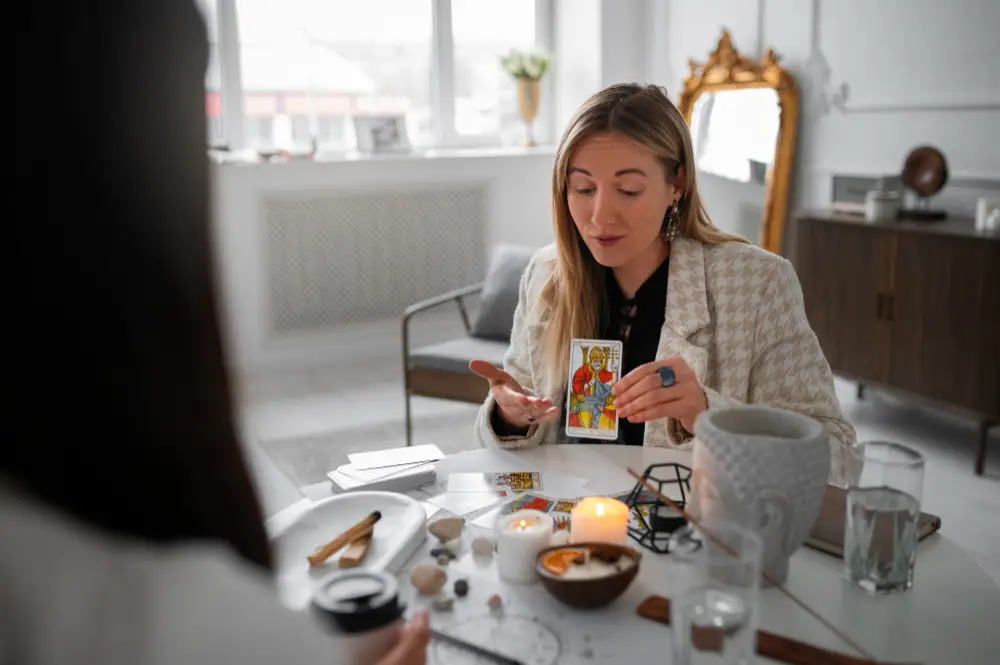
You might be surprised to learn that the reading doesn’t suddenly become a one-way conversation where the reader announces your future. There is usually some back and forth as the reader explains what they are seeing and you consider how, or whether, it connects with your situation.
You may recognise something straight away.
Another card might leave you thinking, “I’m not sure about that.” That’s perfectly fine. You shouldn’t feel pressured to make every card fit.
Sometimes, the meaning becomes clearer as the conversation develops.
A symbol or theme that seemed unclear at first may suddenly make sense when you talk through what is actually happening in your life.
And sometimes, something simply won’t resonate. A thoughtful reader should be comfortable with that too.
The point isn’t to prove that every card has a perfect answer waiting for you. It is to explore the reading carefully enough that you can decide what, if anything, is meaningful to you.
What Can Tarot Cards Actually Tell You?
If tarot isn’t simply there to tell you what will happen, you might reasonably ask: what can the cards actually tell you?
A tarot reading can help you explore a situation from a different angle, especially when you’re stuck between choices or finding it difficult to see what is really going on.
People often bring questions about relationships, work, personal decisions, or situations where they simply want some clarity.
The answer isn’t always a straightforward yes or no.
A reading may bring a pattern into focus, highlight a tension you hadn’t noticed, or encourage you to look at something you have been avoiding.
Imagine you’re unhappy at work but can’t decide whether to stay or leave. The useful question may not be, “Will I get a better job if I resign?” It could be, “What do I need to understand about why I feel stuck here?” That opens up a much more useful conversation about what is happening now and what you might want to consider next.
This is where tarot can offer something valuable: another perspective without deciding for you.
The cards may give you something to think about, but you are still the person who knows your circumstances, weighs your options, and chooses what to do.
So, if a reading can explore possibilities without deciding your future for you, it leads to the next obvious question: does tarot actually predict the future?
Does Tarot Predict the Future Or Is That the Wrong Question?
The honest answer is that a tarot reading shouldn’t be treated as a guaranteed script of your future.
A reading can explore where a situation seems to be heading, what patterns may be developing, and what possibilities you might want to consider.
But there is an important difference between seeing a possible direction and being told that something will definitely happen.
Think about a relationship.
A reading might suggest that communication has become strained or that an old pattern is affecting the relationship. That can give you something worth thinking about. It doesn’t mean the relationship is destined to end. What you say, what the other person does, and the choices you both make can still change what happens next.
This is why the question “What will happen?” isn’t always the most useful one to ask.
Sometimes a better question is:
“What do I need to understand about where this situation is heading?”
That leaves room for possibilities rather than pretending the future is already written.
It also means you should be cautious of anyone who makes absolute promises about what will happen, particularly when those predictions create fear or pressure you to act.
A thoughtful tarot reading can give you another perspective on what may be unfolding. It shouldn’t take your choices away from you.
The cards can be part of the conversation, but they don’t get to make the decisions for you.
Can You Have an Online Tarot Reading?
Yes, absolutely. An online tarot reading lets you connect with a reader from wherever you are, without needing to travel to their location.
What happens during an online tarot reading?
You’ll usually meet with the reader through a video call or another online platform.
At the beginning, you can share what you’d like to explore, whether it’s a relationship, a career decision, or something that’s been on your mind.
The reader will then work with the cards during the session and talk you through what they notice. You can ask questions, share your thoughts, and have a natural conversation as the reading unfolds.
Is an online reading very different from an in-person one?
Not necessarily. The most important parts are still the same: how clearly you communicate, the reader’s approach, the attention they give to your question, and how comfortable you feel during the session.
Being online mainly changes how the reading takes place, rather than what the reading involves.
If you’re considering an online tarot reading, Elaine Astin also offers readings remotely, making it possible to have the conversation from wherever you are.
The format may be different from sitting together in person, but the focus remains on the cards, your questions, and the conversation that develops around them.
How Do You Choose a Tarot Reader You Can Trust?
Choosing a tarot reader is about finding someone clear about what they do, treats you with respect, and doesn’t make promises they can’t reasonably keep.
Look at How They Describe What They Actually Do
Start with the simple things.
Does the reader explain what type of reading they offer? Do they tell you what happens during a session and what you can expect from it?
Clarity is usually a good sign. You shouldn’t have to decode a page of vague spiritual language to understand what you’re actually booking.
Be Cautious of Guaranteed Results
Be particularly careful if someone promises certainty.
A tarot reader can’t responsibly guarantee that a particular person will return to you, that a specific event will happen, that you’ll make a certain amount of money, or that a reading will cure a problem.
A reading can offer reflection and another perspective. It shouldn’t be presented as a guarantee about what life will do next.
Be Wary of Fear Being Used to Sell Another Service
This is an important one.
If someone tells you that something terrible is attached to you, that you’re in danger, or that a negative force needs to be removed, and then immediately offers a paid solution, step back.
A responsible reader shouldn’t frighten you into buying something.
Look for Boundaries
A trustworthy reader understands that you still have choices.
They can interpret the cards and share what they see, while recognising that you may disagree, that the future isn’t fixed, and that you remain responsible for your own decisions.
That matters even more when you’re asking about something emotionally difficult.
Don’t Choose Solely Because Someone Sounds Mysterious
You don’t need dramatic language or grand claims to find a good tarot reader.
In fact, credibility doesn’t have to sound mysterious.
Look for someone who can explain their approach, acknowledge uncertainty, and make you feel comfortable asking questions. Sometimes the most reassuring thing a reader can say is simply, “I don’t know.”
So, What Is Tarot Reading Really About?
By now, it should feel a little less mysterious.
The cards provide the imagery and symbols.
The spread gives those cards structure and context.
Your question gives the reading something specific to explore.
The reader interprets what appears in relation to that question and the wider conversation.
And the conversation matters because a reading isn’t simply a message being delivered to you.
You can question it, recognise something, disagree with something, or discover a perspective you hadn’t considered.
Ultimately, you decide what you take from the experience and what you do with it.
That may be the most useful way to think about tarot: the cards provide the material, the reader helps interpret it, and you decide what it means for you.
Frequently Asked Questions
Q1. Does Psychic Reading Really Work?
A psychic reading can feel meaningful when it gives you a new perspective or helps you make sense of something you’re experiencing. What it can’t do is guarantee a particular future or outcome.
Q2. How Are Psychic Readings So Accurate?
A reading may feel remarkably accurate when what the psychic says connects with your circumstances, emotions, or experiences. The interpretation and conversation can also help bring meaning to what comes through.
Q3. Can I Trust a Psychic Reading?
Look for a psychic who is honest about uncertainty, avoids guaranteed predictions, and respects your ability to make your own choices. A trustworthy reader shouldn’t use fear or pressure to influence you.
Q4. What Should I Expect From a Psychic Reading?
Expect a conversation in which you share what you’d like to explore, and the reader offers their impressions or interpretations. You may be invited to respond, ask questions, and see what resonates with your situation.
Q5. What to Expect From a Psychic Reading
A psychic reading is usually more conversational than people expect: you bring your questions or concerns, the reader shares what they perceive, and together you explore what it might mean for you.